


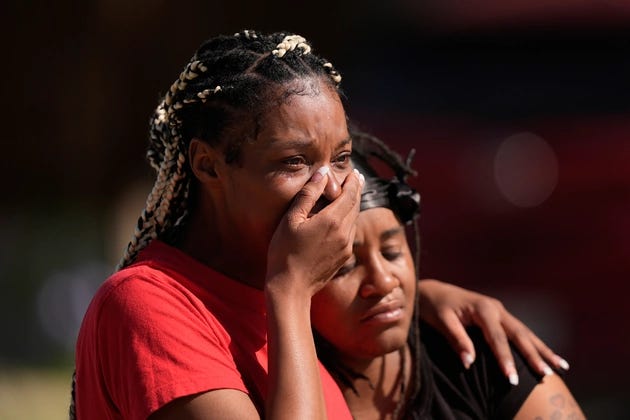
On April 19, a shocking case of gun violence shook Louisiana and the nation. On an otherwise quiet Sunday morning in Shreveport, a Louisiana man shot and killed eight children between the ages of 1 and 12—seven of them his own children—and seriously injured two women, including his wife. He then turned the gun on himself. It was the deadliest mass shooting the country has seen in more than two years. The shooter had recently admitted to a family member that he was struggling with “dark thoughts” and suicidal ideation.
Investigators soon discovered that the gun used in the shooting belonged to another man, himself a felon barred from owning a firearm, who claimed the shooter stole it from his vehicle. That man is now facing federal charges for illegally owning a gun and lying to law enforcement. The charges call to mind recent efforts to hold the enablers of mass shootings accountable—and are a stark reminder of the critical importance of safe storage in preventing tragedies like this one.
The Shreveport massacre was just the beginning. Four days later, a shootout between two groups at the Mall of Louisiana in Baton Rouge left one person dead and at least five others injured, including students from a school on a field trip. And on the same day, a former law enforcement officer was arrested in Florida after authorities determined he had been traveling toward New Orleans with a handgun and roughly 200 rounds of ammunition, allegedly intending to carry out a mass shooting at a festival that draws hundreds of thousands of attendees each year.
In less than a week, Louisiana had become a grim emblem of how pervasive and varied gun violence in America is. The two tragedies and one almost-tragedy weren’t similar in nature—a domestic shooting, a conflict that turned publicly violent, and a foiled hate-motivated plot—but each one illustrates a different dimension of the gun violence crisis that 97Percent exists to address. We don’t write about these events to overwhelm or distress anyone but because the family members in Shreveport, the shoppers in Baton Rouge, and the festivalgoers in New Orleans who were almost victims deserve more than headlines. They deserve a country that takes this seriously enough to act.
And on that front, there are good reasons for hope too, with big legislative wins for gun safety policy in Virginia and Connecticut, and an important federal gun law being upheld by an appeals court.
Let’s take a closer look.

On the Hill
Rep. Thomas Massie is renewing his push to make permitless carry the law of the land nationwide.
In January, Massie introduced the National Constitutional Carry Act, which would prohibit all new state and local laws limiting the carry of firearms in public—and invalidate all old ones.
He argues that permitless carry is a natural extension of the 2nd Amendment and that there is racial bias in the permitting process.
Our research has shown that a majority of gun owners believe that permitless carry increases the chance of gun violence, and they support requirements for firearm purchasers to demonstrate they can use a gun safety.
In the States
Virginia and Connecticut are making leaps in their gun safety policy. While some lawmakers in North Carolina aim to do the same, they face an uphill battle in the state’s legislature.

Gov. Abigail Spanberger has signed into law a groundbreaking suite of gun safety measures passed by the state’s legislature last month.
Among those she signed into law are measures requiring the gun industry to take action to prevent illegal sales, prohibiting carry in many public buildings, and requiring guns to be stored out of view in vehicles.
She also signed a sweeping ban on the manufacture, sale, transfer and possession of unserialized “ghost guns.”
She has not yet signed the high-profile bans on assault-style weapons and large-capacity magazines, instead proposing amendments to clarify which weapons are banned and exempt some firearms used for hunting. The General Assembly has rejected those amendments, leaving the measures in limbo.

Lawmakers are taking action to limit the creation of ghost guns.
The state’s House of Representatives has passed a bill that would ban new sales of Glocks and other handguns that can be easily converted into fully automatic weapons, pending redesign to prevent these conversions.
The move is in reaction to a rising number of police seizures of the “Glock switches” used to make the conversions—despite the devices themselves already being banned.
The bill next heads to the Senate, where it is expected to pass, and then to the governor’s desk.

State Senators have reintroduced a bill that would bar people convicted of domestic violence from owning firearms.
The bill’s sponsors say it would close enforcement gaps in existing laws and improve accountability for offenders.
It would also require universal background checks to own a firearm, revive a previously repealed pistol purchase permit law, and require gun-owning parents of students to affirm that firearms are safely stored at the beginning of the school year.
However, the bill is expected to face fierce resistance in the state’s Republican-controlled House and Senate.
We are big fans of this legislation, because it combines multiple policies that we support—and that consistently earn majority support from gun owners.
In the Courts
An unprecedented investigation in Florida assessing whether an AI chatbot should be held accountable for its role in a mass shooting.
Last year, a gunman killed two students and wounded six others at Florida State University.
Prosecutors say that chat logs between the shooter and ChatGPT show the bot advising him on when he should carry out the shooting and what gun to use.
The case adds to a growing number of attempts to hold AI companies accountable for their technology’s role in mental health challenges and related deaths.
We covered the potential impact of artificial intelligence on gun violence in a recent issue. If you missed it, check it out here.
The 11th Circuit Court of Appeals this week upheld a long-standing federal ban on machine guns.
The challenge to the law was brought by a Florida man who was convicted of possessing a machine gun after he sold three conversion devices to an undercover agent.
He argued that his conviction violated his 2nd Amendment rights.
The court disagreed, saying in its ruling that the 2nd Amendment does not extend to machine guns or conversion devices like those the man had in his possession.
Finally, the federal government is facing a lawsuit from 2nd Amendment groups over its restrictions on carrying firearms in U.S. park buildings.
Visitors to national parks can carry their firearms on park grounds, but not in facilities like gift shops, visitor centers, and fee-collection posts.
The lawsuit says that restriction violates the 2nd Amendment and an earlier finding that required the state of New York to show “exceptional circumstances” justifying restrictions on where people can carry their firearms.
Beyond national parks, the lawsuit could have broader implications on whether people can carry firearms in federal buildings. Stay tuned.
Do you have a comment about any of these critical issues? Do you have a story to share? We’d love to hear from you. Please include your first name and state, and we may publish it in a future issue. Thank you for reading!
For more information about 97Percent, please visit our website at 97Percent.us.
Join our growing community of gun owners and non-gun owners united to reduce gun deaths in America.