

Inside the ATF Shakeup
News Wrap — May 22, 2026


The big news in Washington this week is the $1.776 billion fund that’s been created by the Justice Department to settle President Trump’s lawsuit against the Internal Revenue Service. The fund will be used to compensate people Trump claims have been unfairly targeted through government “weaponization,” including defendants who committed violent acts during the U.S. Capitol attack on Jan. 6, 2021.
One such person is Ryan Nichols. According to the Longview News-Journal:
At the U.S. Capitol, Nichols carried a crowbar and led a crowd of people who pushed police officers, and he used pepper spray against officers, court records show. Nichols entered the Capitol through a broken window, stood on a window ledge, and used a bullhorn to tell a crowd of people: “Get in the building, this is your country, get in the building…This is the second revolution,” court records show. Nichols was sentenced to more than five years in prison for his role in the riot.
Nichols, like all Jan. 6 defendants, was pardoned and released by Trump in 2025.
Now he finds himself back in jail, having been arrested by local police in his hometown of Longview, Texas. Nichols reportedly brandished a firearm outside of a church during a dispute with another man, who was unarmed and holding a Bible, and whose wife and children were nearby. The arrest comes a few months after Nichols announced the end of a congressional campaign, citing “mental health issues” and his divorce.
There’s obviously a lot to unpack here, but the big question is this: was Nichols allowed to own a gun? Typically, a felon would not be. But this case is a little tricky. According to The Trace, Jan. 6 defendants who have received full presidential pardons for their federal offenses are legally allowed to own guns at the federal level. However, their ability to legally possess firearms depends on other factors as well:
No other disqualifying convictions: The pardon only applies to the specific federal charges outlined in the pardon itself. If a defendant has other, unrelated federal or state felony convictions or domestic violence restraining orders, those independent prohibitions remain in effect.
State laws: Even with a federal pardon, state laws vary. Some states maintain strict restrictions or outright bans on firearm possession for individuals with past felony convictions, regardless of a presidential pardon.
What will happen in the Nichols case? That remains to be seen. Stay tuned.

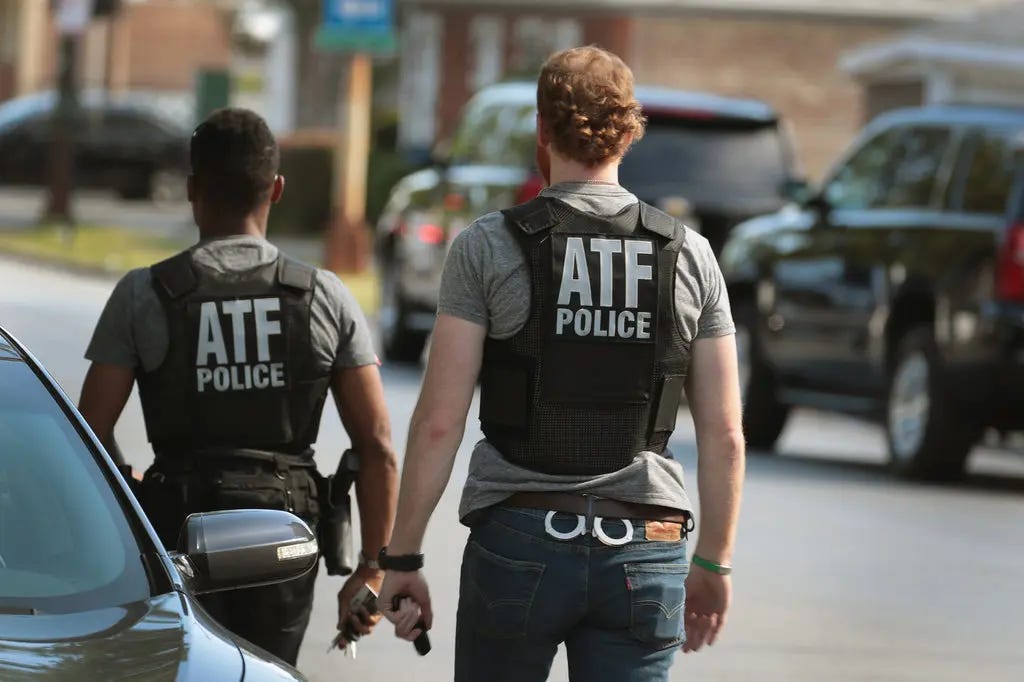
First up, a new director of the Bureau of Alcohol, Tobacco, and Firearms (ATF) has been confirmed by the Senate: Robert Cekada.
The first permanent director of the agency in either Trump term, Cekada’s confirmation also coincides with the DOJ dropping the proposed merger of the ATF with the DEA and a request for a 4% funding bump for the 2027 fiscal year.
But Cekada’s stance on firearms regulation still aligns with the Trump Administration’s promises to roll back some firearms regulations, and he says he plans on revoking a slew of regulations from previous administrations.
Our research shows that gun owners are generally supportive of common-sense gun safety measures like many of those Cekada aims to roll back.
The ATF has already started taking action on the plan, recently releasing details on the first 21 planned changes.
These include a rollback of tightened Biden-era regulations on firearms with stabilizing devices, which are common in mass shootings, and permitting requirements for private sellers of used guns.
Also being pulled back is the first Trump Administration’s attempted ban on bump stocks, in which the ATF is removing the devices from their definition of machine guns.
More deregelation is likely on the way, as the agency has promised a “new era of reform” under the new director.
Also looking to change its firearms rules is Amtrak, which is considering expanding how and where firearms can be carried on its trains.
At present, firearms can only be brought on the handful of trains where they can be secured in locked baggage cars.
Under the proposed changes, gun owners would be able to store them in lockboxes, potentially expanding the number of trains where they can be carried by around 1,500.
Amtrak is pushing forward with consideration of the changes despite the recent shooting at the White House Correspondents’ Dinner, in which the firearms used were allegedly transported to Washington, D.C., on an Amtrak train.
A final story flying under the radar is FBI Director Kash Patel’s praise for his agency’s use of AI.
Speaking on a podcast earlier this month, he claimed that the FBI has used AI to stop multiple school shootings, including one in North Carolina and another in New York, after tips submitted to the agency were efficiently processed by AI.
Patel says that while the FBI of the previous administration resisted the use of AI, he’s “using it everywhere.”
With “every major tech company in the world embedded in the FBI,” the director sees a future for the technology in processing the barrage of tips and other information received by the agency.

Today’s roundup and state and judicial news includes a group of states pushing back against a change in U.S. Postal Service shipping rules. And the Justice Department is challenging local gun laws, even as it pushes for limits on gun rights for undocumented people.
In the States

Twenty-one states are opposing the change in USPS rules that will allow gun owners to ship certain firearms.
In January, the DOJ issued an opinion which judged the long-standing federal ban on mailing certain firearms to be unconstitutional.
The 21 states, which are led by New Jersey, New York, and Delaware, argue in a joint letter that removing that ban is illegal and would allow people barred under local laws from owning guns to access firearms.
It’s not yet clear what the final rule will look like, but the letter foreshadows considerable resistance to it

Meanwhile in Minnesota, the state’s Senate has narrowly approved a sweeping gun violence prevention bill introduced in reaction to the tragic shooting at the Annunciation Church and School last August.
Among other measures, the bill includes bans on assault weapons, high-capacity magazines, ghost guns, and binary triggers, as well as millions in funding for school safety and mental health resources.
In the House, the speaker is being accused of holding it “hostage,” as she refused to allow it to go to the floor.
Though Gov. Tim Walz had promised to sign the bill into law, the legislative session ended last Sunday with no House vote on the bill.

Connecticut state lawmakers have approved a ban on Glock-style pistols, sending it to the governor’s desk.
The ban is motivated by concerns that the firearms can easily be converted into fully-automatic machine guns.
It faces fierce resistance from 2nd Amendment advocates, with Glock-style pistols being extremely popular among gun owners.
But the ban’s proponents say that it will close important legal loopholes for ghost and machine guns and ultimately save lives.
These states are doing the right thing by taking action to curb gun violence, but at 97 Percent we believe that there’s something better than bans.
In the Courts
The Justice Department will soon be heading to court with both Colorado and the state’s capital city, Denver, after it recently filed two separate lawsuits challenging local gun safety measures.
The suit against Denver challenges the city’s ban on assault weapons, which has been in place since 1989 and which the city’s chief of police says has helped address gun violence.
The second suit challenges the state’s ban on high-capacity magazines.
The DOJ argues that both laws violate the 2nd Amendment, but local officials respond that they are effective gun safety measures and promised to fight back.
However, the DOJ is also arguing for limits on gun rights in its case against a man arrested at a traffic stop in Maine.
After admitting to authorities that he was not in the country legally and that he had a pistol in his backpack, the the DOJ attempted to indict the man on a charge of “possessing a firearm as a person who is in the country illegally.”
A court initially ruled that the charge violated the 2nd Amendment, but earlier this month, an appeals court ruled that the DOJ could go ahead with its prosecution.
The case represents a rare attempt by the Trump DOJ to limit gun rights amidst its efforts to roll back firearms regulations and challenge local firearms laws.
In Florida, the state’s Office of the Attorney General is suing the city of Jacksonville for keeping a registry of private gun owners.
Between 2023 and 2025, the city’s mayor’s office kept a registry of people who carried their firearms into two city buildings, something Attorney General James Uthmeier says violates state law.
The lawsuit comes after State Attorney Melissa Nelson chose not to pursue criminal charges, reporting that she had found “no evidence of criminal intent” in the city’s actions.

According to Pew, the latest available CDC data reveal that no less than 44,000 people lost their lives to gun violence in 2024.
While that number fell for the third consecutive year in a row, it still represents one of the highest figures on record.
Of those deaths, the overwhelming majority were caused the result of suicide (62%) and homicide (35%).
What’s more, gun violence makes up a majority of suicides and homicides overall, representing 57% and 76% of cases, respectively.
These statistics showcase the scale of gun violence’s impact, with tens of thousands of Americans suffering its most severe consequences every single year.
Do you have a comment about any of these critical issues? Do you have a story to share? We’d love to hear from you. Please include your first name and state, and we may publish it in a future issue. Thank you for reading!
For more information about 97Percent, please visit our website at 97Percent.us.
Join our growing community of gun owners and non-gun owners united to reduce gun deaths in America.
Extremely sad and misguided of too many towns, cities, and states of the USA to lack strong regulation. So many lives lost and ruined. The people of many other countries, especially in northern Europe, do regulate gun possession and do NOT see such tragic losses of their fellow human beings.