

Maine Just Got Safer
News Wrap - November 8, 2025


On Tuesday, voters in Maine approved a red flag law via ballot measure. The law will make it easier for family members to request an Extreme Risk Protection Order (ERPO), which temporarily restricts a person’s access to firearms when they are deemed a risk to themselves or others.
The law comes after a mass shooting at a bowling alley in 2023, in which 18 people were killed and 13 more injured. The investigation that followed concluded there were multiple opportunities for intervention. But Maine’s “yellow flag law,” in place at the time, failed to prevent the tragedy.
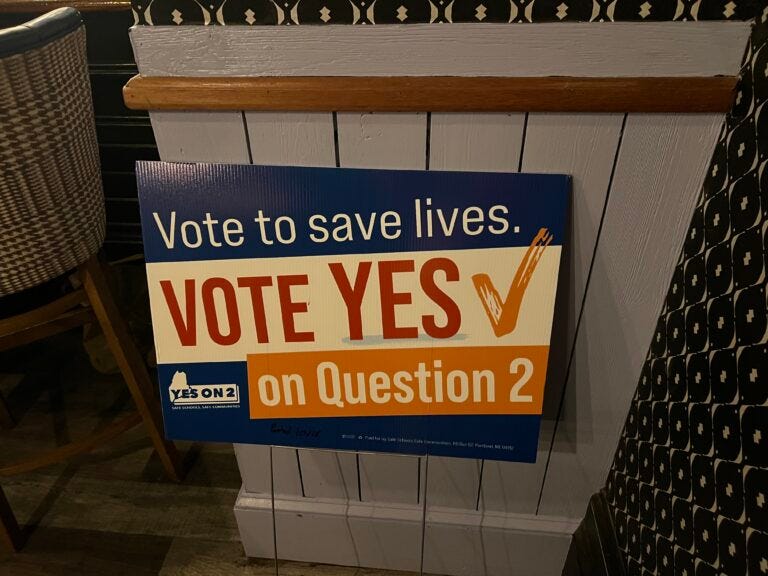
Many shooters talk about their plans or raise alarms with family and friends, and interventions in those cases can be life-saving. There is strong evidence that ERPOs are effective at preventing gun-related homicides and suicides, and our research shows that they are supported by the vast majority of gun owners. We also found that when gun owners learn that these laws incorporate due process provisions like a timely trial and the subject’s right to present evidence, support rises as high as 81 percent.
Maine voters made the right call this week.

On the Hill
Two U.S. Senators have introduced a bill which would mandate that firearms applications and licenses continue to be processed when government shutdowns occur.
Sens. Bill Cassidy (R-LA) and Jim Risch (R-ID) argue that citizens must be able to exercise their 2nd Amendment rights during shutdowns.
While certain permits and licenses are not being handled, the National Instant Criminal Background Check System (NICS) remains operational during shutdowns, as it is deemed essential.
The Trump Administration also recently declared gun examiners essential workers so that purchases of certain highly regulated firearms could continue.
In the States
California is automating firearm surrender alerts, Tuesday’s election saw a gun safety champion win the governorship in New Jersey, and Utah is beginning implementation of a new gun safety program in local schools.
California: Los Angeles County has automated the process of notifying law enforcement agencies when people who violate restraining orders fail to comply with judges’ orders to hand their guns over to authorities.
Previously, court clerks had to identify which of the county’s 88 law enforcement agencies to notify about a firearm relinquishment by looking up addresses for the accused, which could take multiple days.
The new process alerts agencies when a judge has ordered an individual in their jurisdiction to give up their guns.
The new digital approach “represents a major enhancement in public safety,” LA County Sheriff Robert Luna said.
New Jersey: Mikie Sherrill, a strong advocate of gun safety measures, was elected governor of New Jersey.
Sherrill attributes the state’s low firearm death rate to its strong gun laws, and promised to strengthen laws that mandate safe storage and prevent violent criminals from owning firearms.
She also promised to expand law enforcement efforts to implement them.
During her time as a U.S. Representative, she has supported a number of gun safety bills, including to establish the Office of Gun Violence Prevention and to incentivize safe storage.
Utah: The state’s new law requiring schools to offer firearm safety classes has begun implementation.
Parents can opt in or out of a yearly program which will help kids identify and react to unsafe situations involving a firearm.
The curriculum focuses on the principles “stop, leave, and tell an adult,” encouraging kids to turn to adults and not try to handle weapons themselves.
Utah is one of a handful of states that have moved towards this method of firearm violence prevention.
What do you think of Utah’s firearms curriculum? Let us know, and we will publish our readers’ thoughts in our next issue.
In the Courts
As the U.S. Supreme Court considers cases in this term that could have ripple effects for gun laws in states across the country, two states are already facing direct court challenges to their permit laws.
Oregon: The Oregon Supreme Court began hearing a challenge to a state gun-permitting law this past week.
Measure 114 requires a permit to purchase a firearm and bans magazines that can hold more than 10 rounds.
It was approved by voters in 2022 and has since faced a legal battle from a gun rights group that claims it violates the state’s constitution.
Supporters of the law say that it is necessary to keep guns out of the wrong hands. An appeals court previously agreed with them and found it to be valid under the state’s constitution.
Delaware: Plaintiffs have asked a federal judge to delay the implementation of a new Delaware law requiring a permit to purchase a handgun before it goes into effect on November 16.
The plaintiffs aren’t challenging the law itself, but they say that the state doesn’t yet have the infrastructure to issue the permits, and that the law will thus effectively stop all new handgun purchases.
One plaintiff has even called the law “discriminatory.”
The state says it’s fully prepared and that the application system is already live. A hearing date has yet to be announced.

In an interesting cross between faith and gun policy, Catholic bishops across the U.S. are calling for “sensible firearm regulation” in a document issued this week.
The document reaffirms the support of gun regulation long held by the Church.
It identifies an “epidemic of violence” and poses the “preservation of life” as an obligation.
Among others, the bishops advocate bans on assault weapons and large-capacity magazines, universal background checks, and improved access to mental health care.
Do you have a comment about any of these critical issues? Do you have a story to share? We’d love to hear from you. Please include your first name and state, and we may publish it in a future issue. Thank you for reading!
For more information about 97Percent, please visit our website at 97Percent.us.
Join our growing community of gun owners and non-gun owners united to reduce gun deaths in America.
It's heartening to see Maine voters support a law that aims to prevent tragedies by giving familis a way to act when they see a loved one sprialing. The ERPO approach seems like a measured response that balances rights with safety and I hope it will help avoid the failures we saw leading up to the Lewiston shooting. It will be interesing to see how quickly local authorities implement the new system and whether it inspires similar reforms in other states. My hope is that it empowers families and communities to step in before another disaster.