


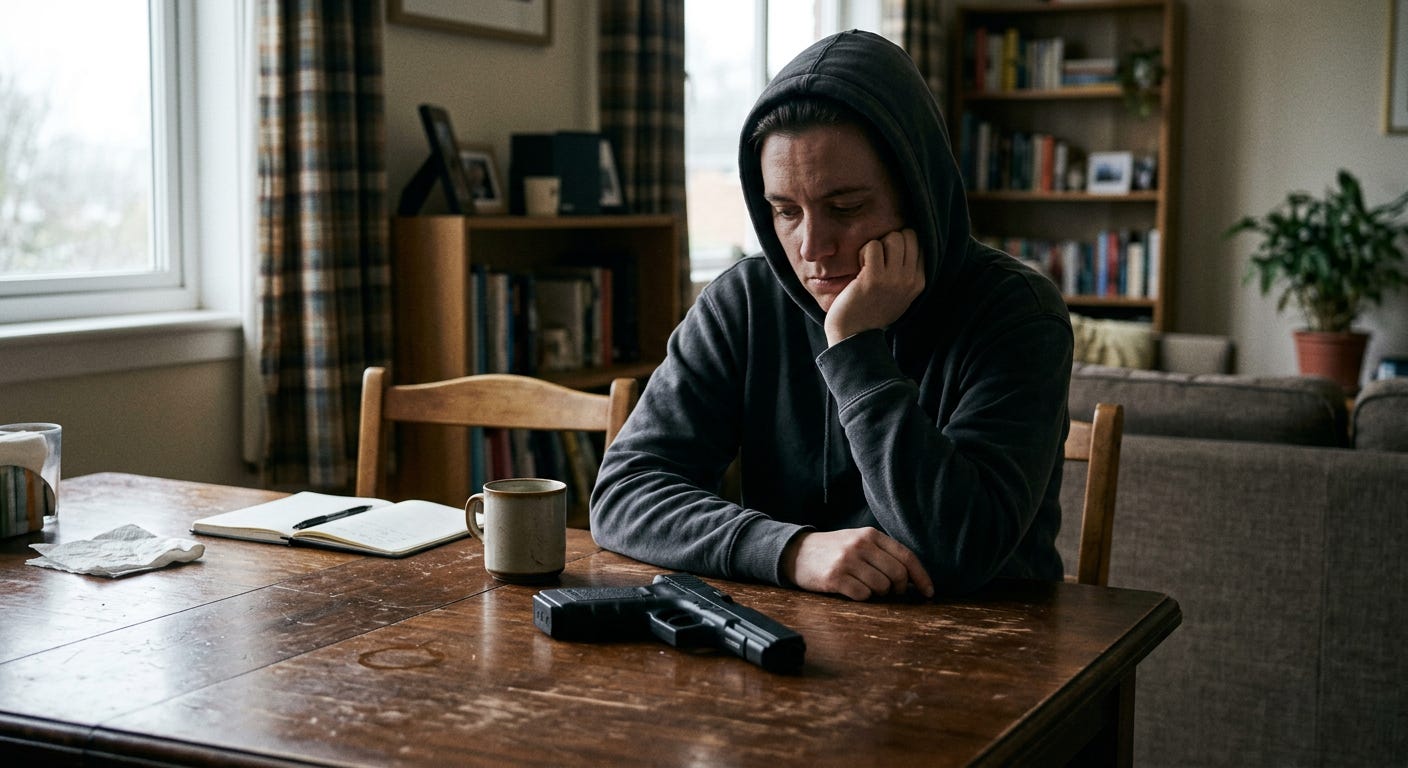
Here’s an unnerving bit of data. A new study indicates that roughly 7 percent of the U.S. population—or 19 million people—has seriously thought about shooting another person in their lifetime. Where did such a sobering stat come from? The National Firearms, Alcohol, Cannabis, and Suicide survey, which is run by the University of Michigan, most recently between May and September 2025.
Among those who say they’ve considered carrying out this violent act at some point in their lives, there are some common risk factors: being younger, living in a city, living in the Midwest, having less formal education. But guess what’s not associated with any higher risk? Being a gun owner. That may surprise some readers, but it doesn’t surprise us at 97Percent, where we know that gun owners are among the most staunch proponents of responsible gun ownership.
Most of that 7 percent of Americans will never carry out the violent act they’ve thought about. Targeted prevention efforts can help in other cases, and on that front, recent weeks have seen a number of wins for gun safety. There was progress in the courts in Connecticut, Ohio, and Texas, and in Virginia, a package of gun safety legislation has been sent to the governor’s desk. Lawmakers in Michigan have introduced gun safety measures, and a new law has gone into effect in Massachusetts.
The view is different at the federal level, however, where the DOJ is eyeing a big change that could impact how gun commerce is regulated and gun crime is investigated.
Let’s dive in.

The Justice Department has proposed combining the ATF and DEA in a move it says would improve the resource and functional efficiency of both agencies.
The agencies often work together but are responsible for distinct regulatory issues.
Critics say the merger would reduce the number of staff and financial resources available to both—ultimately reducing their efficacy in preventing firearm-related crime.
The move is part of broader efforts by the Trump Administration to reduce the size and scope of the federal government, drawing a number of legal challenges.
Simultaneously, the department is facing harsh criticism for a lawsuit it filed last December against the District of Columbia’s Metropolitan Police Department.
The DOJ argues that the district’s ban on semiautomatic and some other firearms violates not only the 2nd Amendment but also a 1994 law banning “unconstitutional practices by law enforcement.”
Now, more than a dozen former U.S. attorneys have said in an amicus brief that the 1994 law is aimed at preventing excessive force and discrimination, not altering other statutes.
They say the DOJ’s application of the law in this manner is “dangerous,” and are calling for it to be “interpreted correctly.” Stay tuned.
Meanwhile, at the Pentagon, Defense Sec. Pete Hegseth signed a memo last Thursday that allows service members to request permission to carry personal firearms on military installations.
The newly allowed locations include bases, naval yards, and recruitment centers.
Hegseth claimed in a video that the policy would allow military personnel to defend themselves in case of an attack.
He cited a 2019 shooting at a naval base in Pensacola, a 2025 shooting at Fort Stewart in Georgia, and a shooting last month at Holloman Air Force Base in New Mexico as examples of the kinds of attacks service members face.

In the States
While Virginia’s governor is considering signing off on a raft of gun safety bills, House Democrats in Michigan are pushing to strengthen their own provisions, and a Massachusetts law is going into effect.

In early March, the state’s legislature passed a slew of gun safety measures, including limitations on where guns can be carried, penalties for unsecure storage of firearms in vehicles, and a ghost gun ban.
Notably, a bill banning any new sale, manufacture, or import of so-called “assault weapons” in the state also passed in this legislative session.
Gov. Abigail Spanberger’s has expressed support for some of the bills and is expected to sign off on many of them. She faces an April 13 deadline to act before all of the measures automatically become law.
In the meantime, local law enforcement is working to dispel online rumors about the new laws.
We applaud Virginia’s leadership on safe storage, ghost guns, and other gun safety issues. But at 97Percent, we believe there’s something better than bans.

New gun safety rules took effect in Massachusetts last Thursday, with anyone applying for or renewing a gun permit now required to take a safety course from an updated list of safety courses.
The updates have spurred frustration among some gun owners, being released just hours before the law went into effect.
The law is part of a package of gun safety measures that supporters say will save lives—but that are facing heavy resistance from gun rights groups.

Democrats in Michigan’s House of Representatives have proposed a bill that would raise the minimum age to buy long guns.
If passed, it would bar those under 21 from purchasing firearms longer than 26 inches, as well as prevent them from carrying these in public without supervision from someone over 21.
While the bill has slim chances of success in the state’s Republican-controlled House, it is an important piece in the broader debate around the need for gun safety measures in the state.
Studies show that age limits on gun purchases can help curb violence, and our research shows that 41% of gun owners believe they are effective.
In the Courts
Gun safety measures also made progress in the courts in recent weeks. In Connecticut and Texas, “sensitive places” laws have survived legal challenges, and in Ohio, the City of Columbus has been allowed to continue its fight to restore a law of its own.

A U.S. District Judge has issued an order upholding a federal ban on firearms in post offices. The lawsuit was brought by Connecticut resident David Nastri of We the Patriots, challenging a 1972 regulation that bans firearms in all post offices.
The judge found that a blanket ban on firearms in post offices is constitutional because, as government buildings, post offices are considered “sensitive locations.” Further, the average post office in the U.S. receives around 200 visitors a day, which means they are “quintessentially crowded locations,” and thus subject to 2nd Amendment regulations.
The ruling passes the Bruen test because of a “well-established and representative tradition of regulating firearms in public forums and quintessentially crowded places, enduring from medieval England to Reconstruction America and beyond,” according to the order.
This Connecticut decision creates a split between the District of Connecticut and the Districts of Northern Texas and Middle Florida, which have ruled against the ban. The Texas case is already headed to the Fifth Circuit. Stay tuned.

Speaking of Texas, a federal court has upheld a state law that bans carrying firearms in certain “sensitive places,” such as sporting events and some alcohol-serving businesses.
The law was first challenged in 2024 by a gun rights group and a number of gun owners, who argued that the law violates the 2nd Amendment and unfairly blocks carry by those not consuming alcohol in such places.
In his decision, the judge argued that the 2nd Amendment is not absolute in all places, and there is a historical tradition of restricting carry in sensitive areas.

The Ohio state Supreme Court ruled last week to allow the City of Columbus to appeal an injunction on its local gun safety legislation.
Since 2022, the city has barred most residents from owning large-capacity magazines and imposed penalties for knowingly storing a firearm where a child can access it.
In 2023, a judge approved an injunction requested by a group of residents, and the city has since been engaged in a years-long effort to appeal the decision.
While the latest decision does not resolve the case, it enables the city to continue its fight to revive the legislation.
A 2019 study showed that even a modest increase in safe firearm storage would result in a 32% decrease in gun deaths from accidental shootings, suicide, and mass violence, and our research shows that 87% of gun owners believe safe storage laws are effective.

Guns and Familial Relationships
A recent study by researchers from Boston Children’s Hospital and Harvard Medical School shows that pregnant women are at a significantly greater risk of gun violence than their non-pregnant counterparts.
The study shows that their risk is about 37% higher.
It also found that homicide is the leading cause of death for pregnant women, with a large proportion of these homicides committed at home.
The study is a reminder that gun violence is a unique threat for women, and curbing it has a special significance for pregnant women and particularly victims of domestic violence.
Should irresponsible gun ownership be a factor in disputes over parental custody? Marcia Zug, Professor of Family Law at the University of South Carolina, says there are good reasons why it should.
Zug argues that there is significant data that suggests having unsecured guns in homes with children present is dangerous.
Other potentially harmful behaviors—like smoking or unstable romantic relationships, for example—are constitutionally protected for the parent, but they are frequently considered when making custody determinations.
Because these other indicators of parental fitness are already common factors in custody cases, Zug says that a failure to properly store and handle firearms is a legally sound incentive for custody loss—and could ultimately help prevent gun deaths and injuries.
What do you think? Let us know.
Do you have a comment about any of these critical issues? Do you have a story to share? We’d love to hear from you. Please include your first name and state, and we may publish it in a future issue. Thank you for reading!
For more information about 97Percent, please visit our website at 97Percent.us.
Join our growing community of gun owners and non-gun owners united to reduce gun deaths in America.